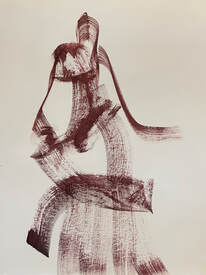
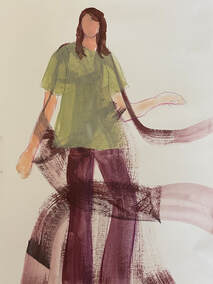
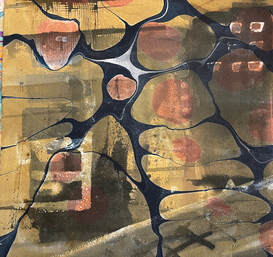
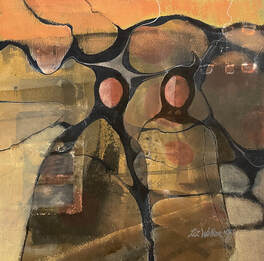
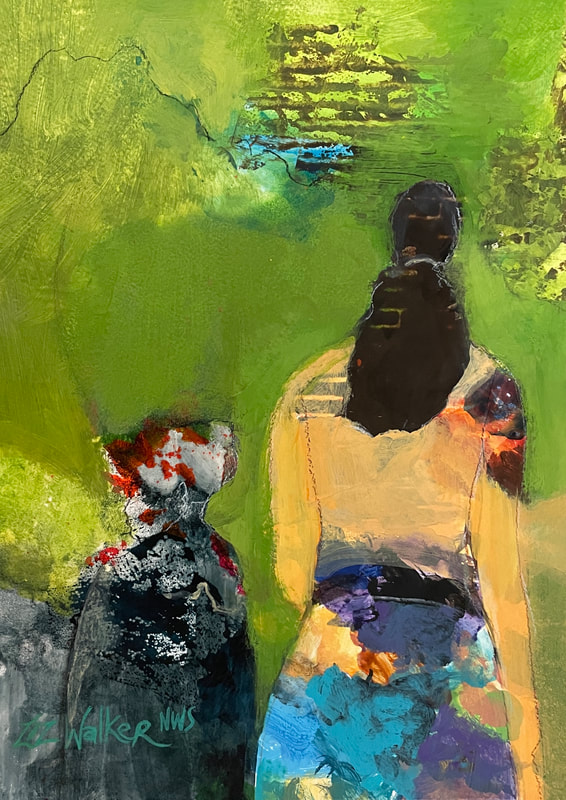
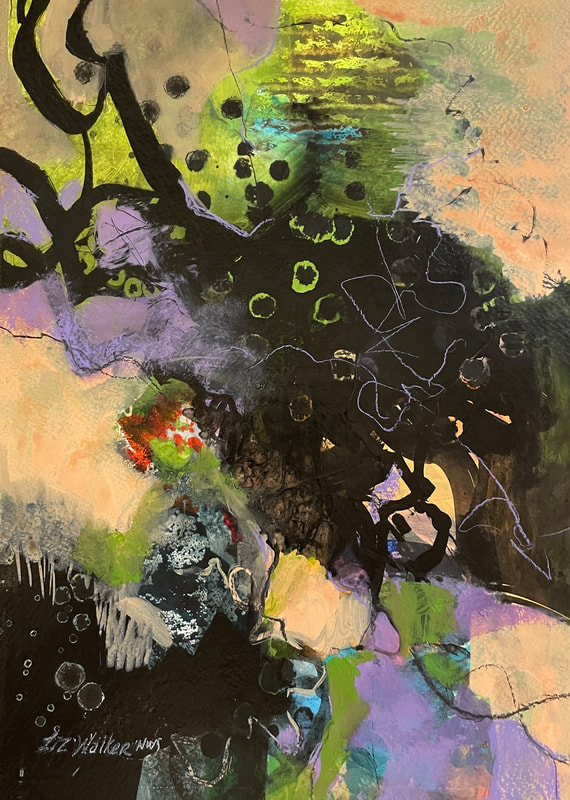
I recently invited Indiana artist and workshop instructor Sue St John to Portland, where she shared her techniques with 22 artists in a 3 day workshop.  We'd long admired each other's work and had been exchanging emails for about a year. She used my painting "Speckled Pears" in Volume 4 of her ebook "A Walk Into Abstracts", and she is keenly interested in other artist's painting process.

Like most artists (myself included), Sue started out doing very traditional, realistic paintings, and then she took an experimental workshop and it changed her style and approach completely. As I watched, learned, and practiced her methods and approaches, I found to my delight that I've now got yet ANOTHER way I can paint--by pouring thinned paint under various types of plastic sheeting (including painter's plastic), letting things sit overnight, and then waking up like a kid on Christmas day to see what I've got.

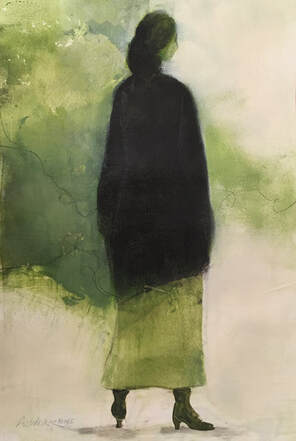
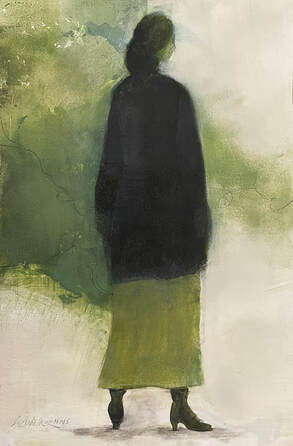
Sue focuses primarily on abstract compositions, but I have found I can adapt her methods to MY preferred subject matter--mostly people, but also florals and still lifes. I've even passed on her methods to some of my acrylic students, who have amazed me (and themselves) with their creatiions. I'm posting some images here--a few "before" and 'after" versions--so you can see how I've turned  these amorphous "starts" into paintings that reflect my style and preferred subject matter. In the course of this workshop, and afterwards, I think I've amassed a dozen or so "starts"--I've got my work cut out for me!

Note: None of these paintings is quite *finished* yet--but I'm making some good progress!
 
 
It's finally here---the end of 2012. As I mull over the large number of unfinished paintings in my studio, I realize that the good (and bad) news is that there are not enough lifetimes to complete all the ideas that run through my head (often at 3am, unfortunately). Nevertheless, I am a lucky person indeed if that's the worst of my troubles.

Normally, December is a fruitful time in my studio. I've finished teaching for the year and can concentrate long blocks of time on painting. However, this year I elected to get carpal tunnel surgery on my right (painting) hand. It's been difficult not being able to do much more than put a daub or two on a painting, but I know I am on the mend and just need to be patient.

Armed with a new ipad (with Siri voice activation), I realized that one thing I could do is make audio notes on paintings, describing how I might fix/finish them in the future. Sometimes just being able to articulate what you want to do to a painting satisfies the creative impulse--at least for the time being.

Here is a small sampling of some of my unfinished paintings---which may or may not see the light of day in 2013.
 
 
My acrylic marbled painting "On The Edge Of Her Seat #1" began simply enough. In my typical fashion, I "sculpted" the figure by muting/overpainting everything around the figure. Back when I began this painting in 2011, I thought I'd successfully completed this painting (see Step 4). I framed the painting, showed it to others who liked it, and put it into a few shows. Looking at it later, I felt like it still needed SOMETHING to make it stronger. So in October 2012, fellow artist  LaVonne Tarbox-Crone took a good look at this painting and taped some "mockup" pieces of magazine clippings to the piece (see Step 5) to show me how I might improve it. A few steps later (adding the horizontal line and then softening it a bit, and adding the white window panes behind the figure), and my painting was finally complete.
 
 
I'm enamored of a new book--a collection of pithy quotes and stories--called "Steal Like An Artist" by Austin Kleon. Clearly this guy has thought long and hard about being an artist--in his case a writer---and he serves up some interesting ideas here.

To quote from his book:

Every artists gets asked the question, "Where do you get your ideas?". The honest artists answers, "I steal them." He goes on to say "first you figure out what's worth stealing, then you move on to the next thing."

And Kleon continues:

What a good artist understands is that nothing comes from nowhere. All creative work builds on what came before. Nothing is completely original. Some people find this idea depressing but it fills me with hope. As French writer Andre Gide put it, "Everything that needs to be said has already been said. But, since no one was listening, everything must be said again."

I couldn't have said it better myself. Let the stealing continue....!


Clearly there's a lot of things that today's do-it-yourself artist has to learn, and most of this has little to do with the process of making art. Many of us are navigating the twists and turns of the digital age and have learned how to build and maintain our own website, set up a blog, digitally photograph our artwork, and share these images on our website and social networking sites.

But what about publishing a full-color book with images of your artwork? It sounds so easy, right? Well...yes and no. It all depends on the software template you choose for the task, and the look & feel you require for your book.

A few years ago, my art mentor Harold Walkup self-published his art  book using software on the website www.blurb.com. I bought a copy of his book and enjoyed seeing his words and images bound together in a professional looking 8 x 11 inch book with a dust jacket. What a great idea!  I signed up for a free account on blurb and downloaded their free software. I selected my book format (8x11 seemed a better choice than 12 x 12, which required much larger resolution .jpgs) and thought I'd get right to work on this project. But I found the templates a little hard to use--things didn't seem to allow me to "drag" them where I wanted to and the prospect of gathering nearly 200 images together (from various places on my hard drive) was daunting.

I decided that since I'm a visual person, I needed to stop and do some planning on paper. I created a little paper storyboard with dozens of pages of "facing page" layouts and began scribbling in chapter names, and grouping my paintings in to categories by subject matter. My idea was to build a book of images from the past 10 years, so as to narrow it down a bit. I went through my website and jotted down titles of my best/favorite paintings into a notebook, and then counted up the number of images in each category to determine how many pages I'd need in each chapter. I capped the book at 160 pages---because on blurb, the prices for printing a book are determined by the number of pages. Now I had my plan!

I set up a series of subdirectories on my computer--each bearing the chapter number and name---and began to copy/paste images of my paintings into the appropriate folder. This is where being organized really pays off---thank goodness I've been keeping my .jpgs stored on external drives and had had the presence of mind to sort them by year of completion.  I also had to print out a list of all my painting titles (easily done in Microsoft Access) so that I had the title, size, and medium for each painting right in front of me.

It was then I got serious about learning how the blurb templates work---it took a bit of trial and error, but at last, I figured out how to drag/drop images, create my own layouts (my paintings don't conform to photography print sizes, so I had to elongate some picture boxes so that my images weren't cropped) and tweak the font size as needed. Blurb's BookSmart templates are pretty amazing--it's like having Adobe InDesign software at your fingertips without the hefty pricetag: you can designate "full bleed" images, and overlay words on top of images. Plus, their templates provide all front and back matter (even columned space for the dust jacket text!).

In the course of a week (several hours a day--this stuff can be addicting), I'd uploaded, resized, captioned, and rearranged all 179 images in this 154 page book. I ran spellcheck, made corrections, print previewed, typed in the pages for the table of contents (they didn't seem to have a program that automatically lets you tag items for inclusion), and then "published" this to their "bookstore". You can make your book private (or share with some individuals), or public (available for viewing and/or purchasing by anyone). You can also set your own pricing for this book (once they calculate the base price for your book, you can add whatever amount  you want, and they "recalculate" the retail price for you. You can also elect to be paid via paypal, which I did.

I held my breath, and place an order for a hard copy dust jacketed book---about $70, since their shipping tends to be about $11 (for one book!), and I'd opted for heavy, matte coated paper. A week later, the book arrived and it's simply stunning. I shared the link to the book on my website, on my Facebook page, and sent out an email to family and close friends.

After getting my email, an art friend/writer asked me why I didn't put my book on amazon.com. Now, here's where things get complicated. As you'd expect, blurb.com only makes money when people ORDER books--so their software doesn't allow you to print to .pdf  which would allow you to get  your book printed elsewhere (and/or sell it from other vendors). So those "free" templates have a cost after all.  At amazon, your book has to have a ISBN number (which you can buy through another site) but most of all, your book has to be able to be uploaded in .pdf format to amazon's CreateSpace (its self publishing software site). This would all be simple if I was writing a novel with no pictures or graphics in it, but of course, a carefully laid out art book like the one I created in blurb cannot be created in MSWord. And so I remain tethered to www.blurb.com--at least for this book. Still,  the experience of holding a finished book in my hands might be its own reward after all. 
 
 
The TV series "Portlandia" coined the phrase "put a bird on it", and though it may be true that many artists use birds in their paintings, the trick is to make it your own. After all, it's just a shape--and a very useful design element around which you can build a painting.

My "Birdland" series consists of almost 30 paintings I've done over the past year or so. I decided to package a few favorites into a set of cards which I'll be selling via my website sometime in September/October. The large 5x7 size makes them suitable for framing. My photographer did a test run at the printer's so I could review the color quality--I'm very pleased with the results.
 
 
Sometimes a painting starts ONE way and then "morphs" into a completely different painting altogether. Such was the case of an acrylic marbling painting I started this spring in anticipation of Portland's annual Rose Show Festival. This year's theme was "Rockin' Roses" (who picks these themes, I wonder?).

My original concept seemed fairly straightforward (or so I thought). I had done a few previous versions of this dancing couple and I thought I'd paint them on a red/white marbled background. I thought maybe I'd add a jukebox, but this vertical orientation made it hard to fit it in. So....I turned the whole thing into a horizontal painting and decided that the couple would be sitting in an old fashioned malt shop. Maybe I could put a jukebox on the left hand side of the painting?

Hm...that left a blank space on the right hand side---I tried putting a sauntering bobby-soxer into the foreground, but she was at an odd angle (that's what I get for trying to make this stuff up) and that jukebox was proving to be a hassle to paint--it didn't flow with the rest of the painting, either.  At this point, I decided to submit a different painting for the Rose Show (good thing--because "On The Rocks with a Twist" won an honorable mention).

A month or so later, while painting in my studio, I came across this failed, abandoned painting, and decided to once more shift the painting BACK to a vertical--and completely change the subject matter one more time.

Ah...that's better---this one is still in progress, but already I'm liking it better than the earlier drafts. Amazing how many coats of paint you can do in acrylics (this is on canvas, so it really holds the paint). Not much of the original painting is left, but still there are some faint indications of the previous shapes. Maybe I should call this one "What Lies Beneath".
 
 
I'm having a great time this week in a workshop taught by Eugene Oregon artist Geoff McCormack. He gave us a demo on how he creates his beautiful rock textures, and I set to work doing a preliminary series I call "Rock Paper Scissors". This colorful painting is #1 in the series; I created a more neutral colored version (changing the drawing/composition slightly) in the #2 version.  These 2 paintings are all watercolor, 10 x 14 inches. I took pictures of both paintings in progress (and still not quite complete--I need to add more values).
Here is the second in the series (Rock Paper Scissors #2). Notice the different composition and the choice of colors.
 
 
Admittedly I haven't been using my blog as often as some artists do, but since I'm very fond of showing & describing how a painting is built (from the ground up), I thought I'd post the various stages of one of my recent paintings "Rose Grid".

You can see that I started out with a mottled, stamped background (this is acrylic on Tyvek paper by the way).

Next, I drew a grid on the paper and created a vase (actually two vases) of flowers.

I added some more flowers and a few leaves (some are collaged on) and called it "Rose Grid". Enjoy!


A few of my fellow artists and I took a workshop from Ed Labadie in which we worked from "chaos to order"---spraying our paper and dropping in acrylic colors, and letting things run together. Then we stand back and evaluate. We might decide to keep things abstract, or (in my case) add some subject matter (fish) to the whole thing. Here's an image of what my painting first looked like, and where I'm at right now....this thing is still in progress, mind you.